Horse Liniment Shin-Band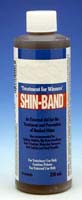
Indications:
Horse Liniment Shin-Band is a rubefacient (counterirritant)
liniment, with antiseptic properties, for use in horses,
as an aid in the prevention of bucked shins and in the
temporary relief of pain and discomfort associated with
splints, osslets, big knee swelling, sore tendons, muscular
soreness, and soft ankles.
Directions
for Use:
For the prevention of bucked
shins in horses: Paint
Horse Liniment Shin-Band one half hour before each workout or race.
DO NOT BANDAGE. Repeat application daily or as recommended
by a veterinarian.
For the relief of temporary
pain and discomfort associated with splints, osslets,
big knee swelling, sore tendons, muscular soreness,
and soft ankles: Apply
with brush to the affected area. DO NOT BANDAGE. Repeat
application once or twice daily on each working day
or as recommended by a veterinarian.
Caution:
For external use only. Apply
Horse Liniment Shin-Band on a clean leg, from which all other medications
have been removed. If condition does not improve after
2 or 3 consecutive applications or if the condition
deteriorates, consult a veterinarian. Warning:
Poison - Keep out of reach of children. Flammable
- Store in a cool place.
Horse Liniment Shin-Band:
cattle supplies, , livestock supplies, cattle medicine, cattle prod, cattle feed, cow supplies, horse medicine, horse supplies, horse drugs, horse medications, horse liniment, horse products, horse supply, horse supplements. One of the more common problems with young horses who are involved in high speed performance is what is called Bucked Shins. Muscles are attached to the bone through a tissue (membrane) called the periosteum which is attached to the bone by a dense fibrous connective tissue. A Bucked Shin occurs when the periosteum tears away from the front of the cannon bone. In young horses the anterior surface of the cannon bone is softer and less dense than in older more mature horses making it more likely that the connective tissue will tear away from the bone under the pressure involved in high speed workouts. There are many factors which affect bone density and good nutrition is critical to bone development in young horses. Exercise is also critical in bone development which means that young horses should be on an exercise program whether it is competitive playing in a large pasture or on a jogging wheel that will increase their bone density through consistent pressure on their bones while moving at an extended trot. Bones will increase in density and strength when they are put under stress. Prevention is by far the wiser and safer course and muscle and bone development is critical for all types of horse. Far too many horse owners think that early development in their horses just naturally takes place without considering the need to build a strong foundation for a future athlete. In the mildest form of the Bucked Shin the periosteum simply tears away from the bone and a hemotoma forms just under the surface which feels like a small bump and there will be a slight amount of heat in the area. Running a finger quickly in a downward motion over the affected area will cause an immediate reaction due to the painful nature of this condition. In the slightly more serious form of the Bucked Shin, the tearing process may produce a tiny micro fracture on the surface of the bone at the tiny individual points of attachment. These micro fractures will heal rather quickly with new bone growth on the surface of the bone. The natural process is for the bone to increase in density in the area of stress. The key is to provide a certain amount of time for the bone to heal and strengthen itself. Too much rest will allow the new bone growth to be reabsorbed, negating the positive effect of the stress. Insufficient rest can cause these micro fractures to spider-web into a larger and more serious stress fracture. Once this occurs the horse will need a significant amount of time-off to allow the fracture to heal. When in doubt an x-ray can determine the degree of damage and provide the necessary information to determine the best course of action. The other part of the damage with the Bucked Shin is in the connective tissue that attaches the periosteum to the bone. These tissues will naturally reattach themselves to the bone but usually with some scar tissue being produced in the process. As a general rule, scar tissue is stronger but less flexible than the original tissue. When you have a wound that is healing you’ve probably noticed that the scar tissue is less flexible and you may stretch and tear open the wound several times before there is enough scar tissue to cover the area without constriction. That stretching and tearing is exactly the same process necessary for the connective tissues to reattach and heal themselves without too much constriction.
.
|












 Cattle Supplies